
Moving a Dog or Cat From Singapore to the UK, Australia, New Zealand or Ireland: Rules Compared
Moving a Dog or Cat From Singapore to the UK, Australia, New Zealand or Ireland: Rules Compared

Of the four countries, Australia and New Zealand quarantine every pet on arrival for at least 10 days.[1][2] Great Britain and the Republic of Ireland hold quarantine in reserve for pets that fail the rules.[3][4] Only Ireland leaves the cabin open, and the airline has the final say.[4] For pet relocation from Singapore, allow at least six months for Australia or New Zealand; the UK and Ireland run on windows measured in days and weeks rather than months.[1][2]
Contents
- Compare the four countries
- Singapore to the United Kingdom
- Singapore to Australia
- Singapore to New Zealand
- Singapore to the Republic of Ireland
- Frequently asked questions
Compare the four countries
Each question has a one-line answer, then a table with one row per country. The rules are those each government published as at 20 October 2026, for pet dogs and cats travelling with their owner from Singapore.
Can my pet fly in the cabin?
In most cases no: Great Britain, Australia and New Zealand require pets to travel as cargo, and only the Republic of Ireland leaves the cabin open, subject to your airline.[5][1][2][4]
| Country | Cabin allowed? | What the rule says |
|---|---|---|
| United Kingdom | No | Cargo only, on an approved route with an approved carrier. GOV.UK‘s exceptions: a chartered private plane, or a guide or assistance dog.[5] |
| Australia | No | Manifested cargo only, arriving directly into Melbourne International Airport.[1] |
| New Zealand | No | Manifested cargo only, landing at Auckland or Christchurch. An assistance dog may fly in the cabin if the airline agrees.[2] |
| Republic of Ireland | Possibly | The Department of Agriculture, Food and the Marine has no objection to an owner-accompanied pet in the cabin; the airline decides.[4] |
Whatever the destination allows, the airline you fly out of Singapore sets its own pet policy, and it can be stricter. Check with the carrier before you plan on the cabin. Our guide to airlines that allow pets in cabins in Singapore covers the carriers’ general limits.
Is quarantine required on arrival?
Yes for Australia and New Zealand, where every pet spends at least 10 days in an approved facility; Great Britain and the Republic of Ireland use quarantine only when a pet does not meet the rules.[1][2][3][6]
| Country | Quarantine? | What the rule says |
|---|---|---|
| United Kingdom | Only if the rules are not met | GOV.UK: your pet may be put into quarantine for up to 4 months if you do not follow the rules, at your cost.[3] |
| Australia | Yes, at least 10 days | Every pet goes to the post entry quarantine facility at Mickleham, Melbourne, for at least 10 days.[7][1] Incomplete documents or unacceptable treatments can mean a longer stay.[1] |
| New Zealand | Yes, at least 10 days | At least 10 days at the transitional facility named on the permit; MPI vet inspections within 72 hours of arrival and at the end of the stay.[2] |
| Republic of Ireland | Only if the rules are not met | Not listed as a step for a compliant pet. An animal that fails a compliance check may be placed in official isolation (quarantine).[6] |
Does my pet need a rabies blood test (titre test)?
No, for all four countries: each recognises Singapore as rabies-free or as a listed country, so the blood test for pets from higher-risk countries does not apply.[8][1][9][10]
| Country | Blood test? | What the rule says |
|---|---|---|
| United Kingdom | No | Singapore is a listed country; the blood test applies only to unlisted countries.[8] A rabies vaccination at least 21 full days before travel is still required.[11] |
| Australia | No | Singapore is a Group 2 (approved rabies-free) country in DAFF’s step-by-step guide. The titre test (RNATT) is a Group 3 requirement.[1] |
| New Zealand | No | Singapore is a Category 2 country, recognised as rabies-free, on MPI’s country list.[9] The 2026 standard’s rabies vaccination and blood test rules apply to Category 3 only.[2] |
| Republic of Ireland | No | Singapore is on the EU list of third countries whose pets need no rabies antibody titration test.[10] A rabies vaccination is still required.[12] |
Do I need an import permit or a health certificate?
Australia and New Zealand require an import permit; Great Britain and the Republic of Ireland require no permit, but your pet must carry a health certificate from an official veterinarian, valid for entry within 10 days.[1][2][13][14]
| Country | Permit? | What the rule says |
|---|---|---|
| United Kingdom | No permit | A Great Britain pet health certificate, signed, stamped and dated by an official veterinarian; entry within 10 days of issue.[13] |
| Australia | Yes | A DAFF import permit, applied for through BICON as soon as you intend to travel. Most issue in 20 to 40 business days; some take up to 123.[1] |
| New Zealand | Yes | An MPI import permit. Apply at least 8 weeks ahead; allow 30 working days.[2] |
| Republic of Ireland | No permit | Advance notice through the Department’s portal at least 24 hours before departure; the pet arrives within five days of you.[4] An EU animal health certificate from an official veterinarian, valid for entry within 10 days.[14] |
How far ahead should I start?
At least six months ahead for Australia or New Zealand; for Great Britain and the Republic of Ireland the fixed windows are short, and the 21-day wait after the rabies vaccination is usually the limiting factor.[1][2][11][12]
| Country | Lead time | What the rule says |
|---|---|---|
| United Kingdom | Weeks, not months | Rabies vaccination at least 21 full days before travel.[11] Dogs: tapeworm 24 to 120 hours before arrival.[15] Certificate valid 10 days.[13] |
| Australia | At least 6 months | DAFF: allow at least 6 months for health checks, tests and paperwork; microchip identity check at least 180 days before export.[1] |
| New Zealand | At least 6 months | Microchip verified by an official vet at least 6 months before shipment; permit 8 weeks plus processing.[2] The 2026 standard applies from 1 July 2026; the 2021 standard is accepted until 1 April 2027.[2] |
| Republic of Ireland | Weeks, not months | No official lead time published. Fixed windows: 21 days after vaccination, 10-day certificate validity, 24-hour advance notice.[12][14][4] |
Singapore to the United Kingdom
To take a dog or cat from Singapore into Great Britain you need a microchip, a rabies vaccination given at least 21 days before you travel, a Great Britain pet health certificate issued within 10 days of arrival, and, for dogs, a tapeworm treatment one to five days before you land.[11][13][15] There is no blood test, and quarantine applies only if the rules are not followed.[8][3] These rules cover England, Scotland and Wales; Northern Ireland is in the FAQ below.
What your pet needs
- A microchip fitted before, or with, the rabies vaccination; the pet must be at least 12 weeks old.[11]
- A rabies vaccination at least 21 full days before travel, counting from the day after the jab.[11] No blood test, because Singapore is a listed country.[8]
- A Great Britain pet health certificate signed, stamped and dated by an official veterinarian, with entry within 10 days of issue.[13]
- Dogs only: a tapeworm treatment given by a vet 24 to 120 hours before arrival, recorded on the certificate.[15]
- Cargo travel on an approved route; Singapore Airlines is listed for Heathrow, Gatwick and Manchester.[5][16]
- A signed non-commercial declaration, and arrival within five days of your own travel.[3]
Step-by-step timeline
- Microchip, then rabies vaccination (or both on the same day).[11]
- Wait 21 full days from the day after the vaccination.[11]
- Book an approved route and carrier into Great Britain.[5]
- Within 10 days of arrival: official vet issues the Great Britain pet health certificate.[13]
- Dogs only: tapeworm treatment 24 to 120 hours before arrival.[15]
- Fly; your pet is checked on entry.[13]
How this differs from the other three
Great Britain is the only destination with a dog-only tapeworm rule, and with Ireland one of two where a compliant pet is not sent to quarantine.[15][3] See the comparison tables. Jason’s Pet Relocation books the approved route, arranges the official vet appointments and prepares the certificate. Get a quote for your pet’s move. Back to contents
Singapore to Australia
Australia has the strictest entry rules of the four. Your pet needs an import permit from DAFF, a microchip identity check at least 180 days before export, a set of treatments and tests in the 45 days before the flight, and a stay of at least 10 days at the Mickleham quarantine facility in Victoria.[1] Start at least six months before your flight.[1] Singapore is a Group 2 rabies-free country, so no rabies blood test is required.[1]
What your pet needs
- A DAFF import permit through BICON, applied for as soon as you intend to travel; most take 20 to 40 business days.[1]
- An ISO-compatible microchip, scanned by a government-approved vet, with identity verified at least 180 days before export.[1]
- No rabies titre test: Singapore is a Group 2 country and the test applies to Group 3.[1]
- Dogs: a canine influenza vaccination, which DAFF requires for dogs from Singapore, plus the treatments, tests and clinical examination in the Group 2 guide; cats follow their own Group 2 guide.[1][17]
- A health certificate endorsed by an official government veterinarian within five days of export.[1]
- Manifested cargo directly into Melbourne, then at least 10 days at Mickleham.[1][7]
Step-by-step timeline
- At least 6 months out: microchip scanned and identity verified by a government-approved vet.[1]
- As soon as travel is intended: apply for the import permit through BICON.[1]
- Permit issued: book the Mickleham quarantine place and the cargo flight into Melbourne.[1][7]
- Dogs, before the final 45 days: canine influenza vaccination and the leptospirosis vaccination or test.[1]
- Final 45 days: tests and parasite treatments as the Group 2 guide sets out.[1]
- Final 5 days: clinical examination and government-endorsed health certificate.[1]
- Fly to Melbourne; at least 10 days in quarantine; release.[1]
How this differs from the other three
Australia is the only destination with a canine influenza requirement for dogs from Singapore, and the only one with a single arrival airport.[1] See the comparison tables. Jason’s Pet Relocation manages the permit, the test schedule and the quarantine booking as part of our pet export service. Get a quote for your pet’s move. Back to contents
Singapore to New Zealand
New Zealand asks you to start early: your pet’s microchip must be scanned and verified by an official veterinarian at least six months before the flight.[2] After that you need an MPI import permit, a place booked at an approved transitional facility for at least 10 days, and a cargo flight into Auckland or Christchurch.[2] Singapore is a Category 2 country, recognised as rabies-free, so no rabies blood test is required.[9][2]
What your pet needs
- A microchip scanned and verified by an official veterinarian at least 6 months before shipment, with the check reported to MPI.[2]
- An MPI import permit: apply at least 8 weeks ahead and allow 30 working days for processing.[2]
- No rabies blood test: Singapore is in MPI’s Category 2 list of countries recognised as rabies-free.[9]
- Parasite treatments, a heartworm test for dogs aged 7 months or older, and a vet inspection in the 2 days before shipment.[2]
- A health certificate from an official veterinarian, every page stamped, signed and dated.[2]
- Manifested cargo into Auckland or Christchurch, then at least 10 days at the facility named on the permit.[2][18]
Step-by-step timeline
- At least 6 months out: microchip verified by an official vet.[2]
- At least 8 weeks out: apply for the MPI import permit; allow 30 working days.[2]
- Book the transitional (quarantine) facility named on the permit.[2]
- Final 30 days: internal parasite treatments; heartworm test for dogs.[2]
- Final 2 days: veterinary inspection and official certificate.[2]
- Fly into Auckland or Christchurch; inspection within 72 hours; at least 10 days in the facility; second inspection; release.[2]
The 2026 Import Health Standard came into force on 1 July 2026, and the 2021 standard is accepted until 1 April 2027.[2][19] This article will be reviewed before that date.
How this differs from the other three
New Zealand shares Australia’s six-month lead time and 10-day quarantine, but accepts two arrival airports and sets no rabies vaccination requirement for a Category 2 country.[2] See the comparison tables. Jason’s Pet Relocation times the microchip check, the permit and the facility booking. Get a quote for your pet’s move. Back to contents
Singapore to the Republic of Ireland
The Republic of Ireland is the one destination of the four where your pet may be able to fly in the cabin with you, if your airline agrees.[4] You must give advance notice through the Irish Department of Agriculture’s online portal, arrive at an approved port or airport, and travel within five days of your pet.[4] Your pet also needs a microchip, a rabies vaccination at least 21 days before travel and an EU animal health certificate; no blood test, because Singapore is an EU-listed country.[12][14][10]
What your pet needs
- A microchip, fitted before the rabies vaccination.[12]
- A rabies vaccination completed at least 21 days before travel.[12] No blood test, because Singapore is on the EU’s list of third countries.[10]
- An EU animal health certificate from an official veterinarian in Singapore, endorsed by the competent authority, valid for entry within 10 days.[14]
- Dogs only: a tapeworm treatment 24 to 120 hours before entry.[12]
- Advance notice through the Department’s Advance Notice Portal at least 24 hours before departure.[4]
- Arrival at an approved entry point: Cork Airport, Dublin Airport, Dublin Port, Shannon Airport, Ringaskiddy or Rosslare.[4]
- Your pet arrives with you or within five days of you; families with more than five pets follow different rules.[4]
Step-by-step timeline
- Microchip, then rabies vaccination.[12]
- Wait at least 21 days after the vaccination.[12]
- Within 10 days of travel: official vet issues the EU animal health certificate, endorsed by the competent authority.[14]
- Dogs only: tapeworm treatment 24 to 120 hours before entry.[12]
- At least 24 hours before departure: submit advance notice through the portal.[4]
- Arrive at an approved entry point, within five days of your pet.[4]
How this differs from the other three
Ireland is the only one of the four where the authority leaves cabin travel to the airline, and the only one that asks for advance notice through a portal rather than a permit.[4] See the comparison tables. Jason’s Pet Relocation prepares the EU certificate, files the advance notice and confirms the carrier’s cabin policy. Get a quote for your pet’s move. Back to contents
Steps on the Singapore side, whichever country you are going to
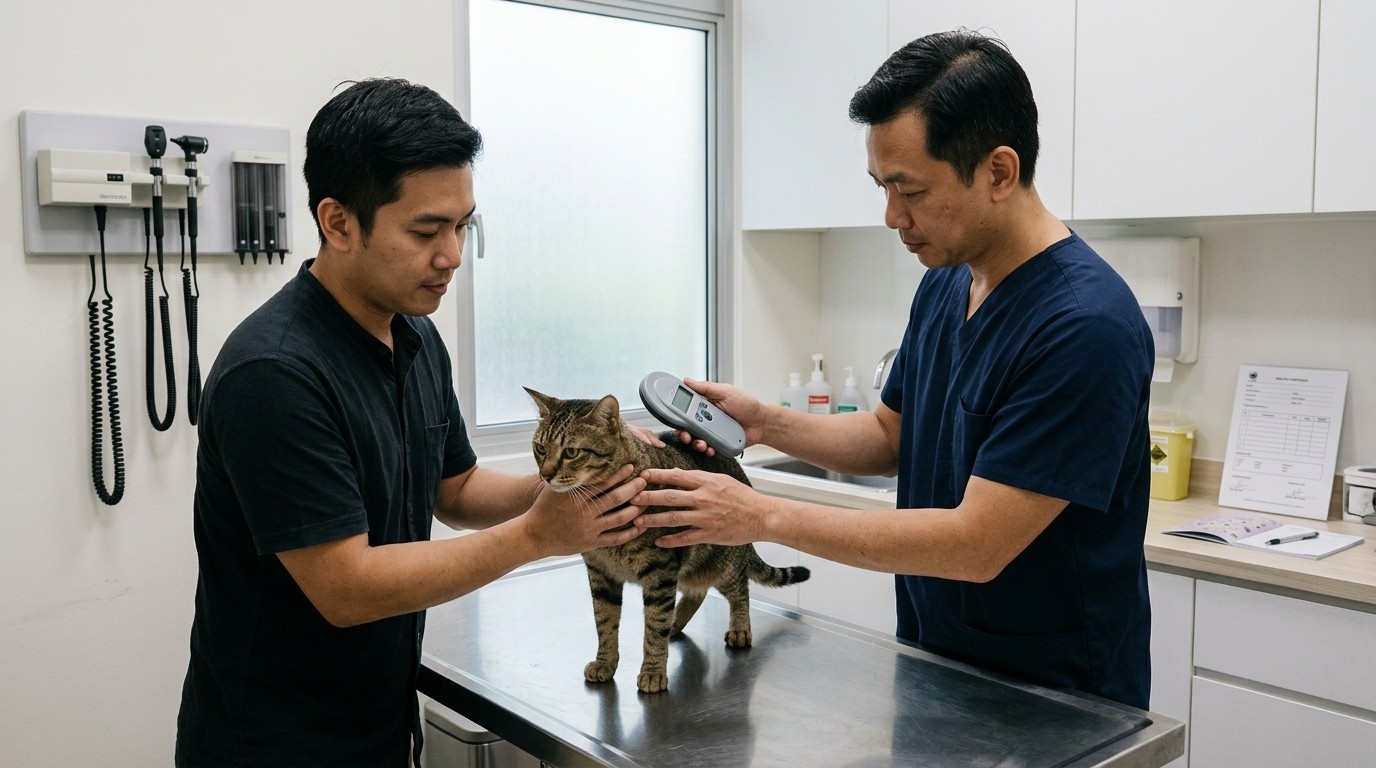
Whatever the destination, the Animal & Veterinary Service (AVS) sets the steps for a pet leaving Singapore.[20]
- Check the destination’s import requirements first; AVS asks owners to confirm the vaccinations and tests needed before anything else.[20]
- Apply for an AVS export licence through the GoBusiness Licensing Portal. It is required for every pet leaving Singapore and valid for 90 days: S$50 and two working days for normal service, S$100 and one working day for express. The owner or an AVS-recognised pet agent applies.[20]
- Obtain a veterinary health certificate from an AVS-licensed private vet. Where the destination requires government endorsement, as all four here do, AVS endorses the destination’s template: S$23 and two working days for normal service.[20]
- If the destination requires a pre-export inspection, book it at the Changi Animal & Plant Quarantine Station at least five days before departure.[20]
- Arrange the cargo booking with the airline and its ground handling agent, SATS or dnata.[20]
- On the day, carry a copy of the export licence and the original health certificate; cancel your Singapore dog licence once your dog has left.[20]
Jason’s Pet Relocation prepares the licence application, the certificate and the cargo booking, while you hold the microchip and vaccination records. For the full process see our 2026 guide to exporting pets.
What the move costs
No two moves cost the same, but five things decide most of the price.
- Your pet’s size and crate. The crate must meet airline standards for the animal’s size, and the chargeable weight of pet plus crate drives the airfreight cost.
- The route and airline. A direct cargo flight is priced differently from a routing with a stop, and each carrier sets its own live-animal rates.
- Quarantine fees at the destination. Australia charges for the reservation, import processing and each day at Mickleham, and DAFF publishes its quarantine fee schedule and reviews it annually.[21] New Zealand’s transitional facility stay is a separate cost to budget for.
- Vet and paperwork fees. Vaccinations, tests, the AVS export licence, certificate endorsement and official vet appointments.[20]
- Door-to-door handling. Collection in Singapore, airport handling at both ends and delivery to your new address.
The ranges below are indicative, drawn from past jobs, and dated. Request a quote for a figure that matches your pet and your dates.
| Destination | Notes |
|---|---|
| United Kingdom | No quarantine fees for a compliant pet |
| Australia | Includes at least 10 days at Mickleham |
| New Zealand | Includes at least 10 days at a transitional facility |
| Republic of Ireland | No quarantine fees for a compliant pet |
Frequently asked questions
Can my pet fly in the cabin to the UK, Australia, New Zealand or Ireland?
No for the UK, Australia and New Zealand: pets go as cargo, with the exceptions in the first comparison table (a chartered private plane, assistance dogs).[5][1][2] The Republic of Ireland is the only one where the authority does not object to cabin travel, but the airline decides.[4]
Which of the four countries has no quarantine?
Great Britain and the Republic of Ireland apply quarantine only to a pet that fails the rules or a compliance check.[3][6] Australia and New Zealand always quarantine, for at least 10 days each.[1][2]
Does my pet need a rabies blood test for each country?
No for all four. Great Britain lists Singapore, so the test for unlisted countries does not apply.[8] Australia and New Zealand class Singapore as rabies-free, in Group 2 and Category 2 respectively.[1][9] Ireland follows the EU list, which includes Singapore.[10]
Can I take my pet to Northern Ireland on the Ireland rules?
No. Northern Ireland is governed by DAERA, which is neither the Republic of Ireland’s Department of Agriculture nor the GOV.UK Great Britain scheme.[3][22] Contact DAERA for its pet travel rules, or get a quote for your pet’s move and we will work through the route with you.
Which country needs the longest preparation?
Australia and New Zealand, at six months each. DAFF says to allow at least 6 months, with the microchip check at least 180 days before export.[1] MPI requires the microchip verified at least 6 months before shipment.[2] Great Britain and Ireland run on windows of days and weeks.[11][12]
Can cats go as well as dogs?
Yes, all four accept both. Great Britain’s tapeworm treatment applies to dogs only.[15] Australia publishes separate Group 2 guides for dogs and cats.[1][17] New Zealand’s 2026 standard is one document covering cats and dogs together.[2]
Sources
The facts in this article come from the official pages below, all read on 20 October 2026.
- GOV.UK: which pet travel document you need
- GOV.UK: Great Britain pet health certificate
- GOV.UK: rabies vaccination, boosters and blood tests
- GOV.UK: approved travel routes and companies
- DAFF: how to bring your dog to Australia from a Group 2 country
- DAFF: how to bring your cat to Australia from a Group 2 country
- MPI: Import Health Standard for cats and dogs (2026)
- MPI: bringing cats and dogs to New Zealand
- gov.ie: Pet Travel (updated 5 August 2026)
- EUR-Lex: Implementing Regulation (EU) 2026/636, list of third countries
- AVS: exporting dogs and cats from Singapore
Moving to the UK, Australia, New Zealand or Ireland with a dog or cat? Jason’s Pet Relocation handles the paperwork, the vet timeline and the flight for each route. Get a quote for your pet’s move.
Resources
[1] Australian Department of Agriculture, Fisheries and Forestry (DAFF) – How to bring your dog to Australia from a Group 2 country
[2] New Zealand Ministry for Primary Industries (MPI) – Import Health Standard: Cats and Dogs (2026)
[3] GOV.UK – Bring your pet dog, cat or ferret to Great Britain
[4] gov.ie, Department of Agriculture, Food and the Marine – Pet Travel
[5] GOV.UK – Bring your pet to Great Britain: travel routes and companies
[6] gov.ie, Department of Agriculture, Food and the Marine – DAFM announces opening of applications from private operators to be an approved quarantine facility for cats, dogs and ferrets
[7] DAFF – Quarantine in Australia for cats and dogs
[8] GOV.UK – Bring your pet to Great Britain: which pet travel document you need
[9] MPI – Specified Approvals for Animal Import Health Standards (MPI-STD-SAA), Schedule 9
[10] European Union (EUR-Lex) – Commission Implementing Regulation (EU) 2026/636, Annex II list of third countries
[11] GOV.UK – Bring your pet to Great Britain: rabies vaccination, boosters and blood tests
[12] European Union (EUR-Lex) – Commission Delegated Regulation (EU) 2026/131 on the non-commercial movement of pet animals
[13] GOV.UK – Bring your pet to Great Britain: Great Britain pet health certificate
[14] European Union (EUR-Lex) – Commission Implementing Regulation (EU) 2026/705, animal health certificate for non-commercial movement
[15] GOV.UK – Bring your pet to Great Britain: tapeworm treatment for dogs
[16] GOV.UK – Approved air routes for pet travel
[17] DAFF – How to bring your cat to Australia from a Group 2 country
[18] MPI – Quarantine facilities when importing cats and dogs (2026 process)
[19] MPI – Bringing cats and dogs to New Zealand
[20] Animal & Veterinary Service (AVS), National Parks Board Singapore – Exporting dogs and cats from Singapore
[21] DAFF – Post entry quarantine fees for cats and dogs
[22] DAERA (Northern Ireland) – Travelling with pets